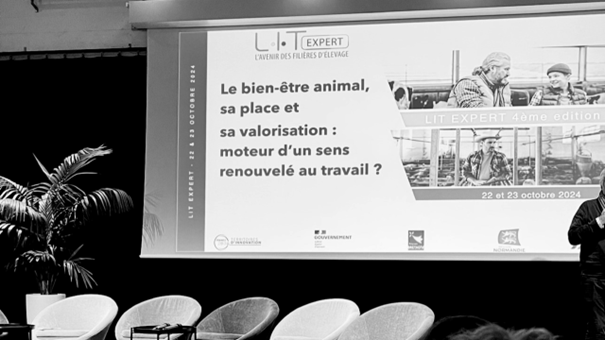
Agency Mégane Klein Architecte attended the new LIT Expert Days 2024 LIT Westerel 22 and 23 October on the theme: « Animal welfare, its place and its valorisation: a motor for renewed sense at work? »
The subjects of reflection were treated with depth and enthusiasm around the term animal welfare which was obviously presented as completely inseparable from that of the breeders, in different types of holdings and even through different generations. It is clear that all the protagonists in the field are seeking to capture by different means this yet delicate concept to be incorporated into the very practice of breeding. This colloquium, which is particularly rich in research and experimentation, shows that everyone wants to incorporate the concept of BEA into their daily practice, and that this has a rather positive effect on activity, and that it is above all a pride they want to communicate.
However, it is quickly realized that there are as many definitions of the BEA concept as people who talk about it., and that the nuances around it do not all have the same value. Between the mere respect for the basic concepts of the BEA (which are not sufficient to express the real account of it), some errors in interpreting the real physiological or biological needs of animals, or even unsure by continuing to consider that their needs are not far from the same as ours; the terms BEA quickly becomes a concept « Tote » which then loses its depth. Added to the fact that the BEA cannot be treated as an isolated theme since it is closely linked to all other performance underlying the good profitability of an agricultural holding; conflicting injunctions are numerous, even discouraging.
Changing the living conditions of the animals directly affects the working conditions of the farmer, and we find that animal welfare can also unfortunately degrade working comfort and farm performance (difficulty of access to animals for care, more handling, mental load, risks, working time, more space per animal means less profitability for farmers if the increase in selling prices does not follow...). The improvement of the living conditions of animals is therefore not necessarily synonymous with an increase in the well-being of farmers at work. The question then arises as to whether, in the end, it is not impossible to satisfy both sides substantially, since the concept of BEA can only be truly adopted when the means used are technically and economically viable.
The future of animal husbandry was also discussed, which is still in a search for global competitiveness, will rather be expansive type with much more animals and even larger buildings. The tripartite relationship between man-animal-environment opens up even more contradictions between the desire to implement virtuous practices and the need to produce faster. The impact on the territories would not be without consequences.
Very quickly, we find ourselves in cascade philosophical impasses. Pilot projects are a representation of a willingness to move forward, and all approaches, whatever they may be, are remarkable on their scale and are undoubtedly to be valued. However, we must first distinguish between « Livestock » and « production » which do not allow the same range of specific actions for improving the BEA. There are as many parameters as there are breeders, as there are types of farms. Also, the BEA is a subject to be applied tailored to the financial possibilities and moral objectives of the breeder.
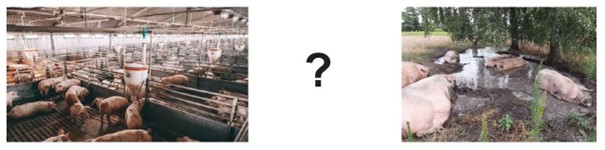
We note that research on animals is increasingly accurate, referenced and disseminated, and in their reading we cannot deny that Incoherence between the artificial environments imposed on them and their specific characteristics arising from their species. It is a pity not to value more, through new, more suitable breeding buildings, all this work (researchers, ethologists, breeders, etc.) of extraordinary wealth. Unlike the animal that evolves in a natural environment where it is not our duty to avoid the frustrations they might encounter, here we have the right to live (and to die) on farm animals. We therefore take responsibility. It is up to us to give a material form to this honourable and indispensable task.
I continue to believe that we can reinvent livestock buildings while taking into account the multitude of constraints associated with breeding, and that this is a will that must first come from the breeder and his priorities. I thought before that the first brake on the more concrete integration of the BEA was the financial envelope, except that if the price is the same (and I am convinced that these are above all different choices to be made at the right time), this is not enough to convince the actors in the agricultural field that we can go even further. Herders who will introduce even more innovative and experimental concepts in their buildings will be pioneers before being examples.