
An architect at the symposium « The farm building, a meeting point between man and animal »
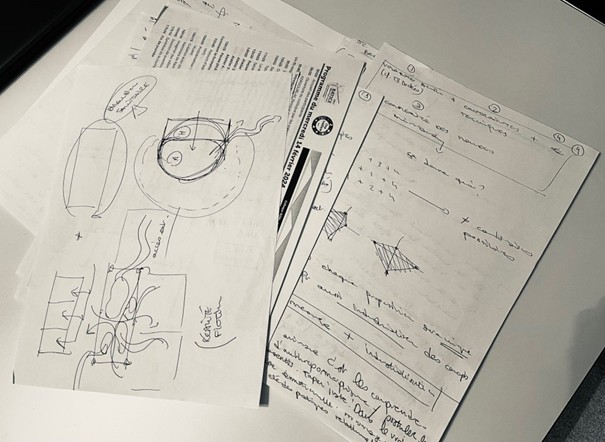
When I pointed at the idea that one could go even further than the work that was presented, it was said that « I'd rather see the glass half full than half empty ». I say that « The more empty the glass, the stronger the steps will be ».
It is imperative to make all our efforts at the crossroads of many disciplines even more concrete to improve the conditions of breeding, both in man and animal, through ever more concrete actions. The objective for the main concerned is twofold; feeling better and feeling understood (both for man and animal). As far as livestock farmers are concerned, the media constantly remind us of the heavy and various responsibilities that these professionals carry on their shoulders, although those that were mainly of concern to us during these two days are their responsibilities towards the livestock, which they hold, and whose life they control (after death). Indeed, far from being anecdotal, it is the status of the animal (annuity) that usually refers the worst representations of the profession to the consumer and society. The very image of breeding can be deeply impacted, and at the other end of the chain, remains a sense of helplessness.
Through the prism of several disciplines represented by ethologists, researchers, ergonomists, farmers, agronomists, veterinarians, zootechnicians, an architect... how the breeding building could evolve soon, a meeting point between man and animal, which is a crystallizer of many of the stakes.
We quickly realize the antinomic dimension of many concepts. A priori, the conditions for improving the holding of farmed animals require the degradation of zootechnical principles and would impact the financial profitability of the holding. The objective is great, since it seems to admit only compromises.
So how can we encourage the exploration of complexity? What makes you work well in a building? Both terms « animal welfare » and « Livestock » Are they compatible? How can we admit to looking for mostly positive emotional states during herding life when the goal is death?
In this density of scientific knowledge and philosophical, societal and sociological reflections, it is first and foremost a question of deconstructing the cultural heritage that we sometimes perpetuate despite ourselves. How can we link such a complex subject with concrete proposals? The idea of bringing together a diverse panel of professionals and experts is indispensable, rich and risky. As relevant and documented as all the research and work presented; It is sometimes necessary to agree to question the merits of each of the steps, to ask them again and again from different perspectives. But it is by venturing into confrontation, leaving a certain area of comfort, that the possibilities of embarking on a new transition arise. Together.
As in all projects, there are as many projects as there are clients. As many solutions as architects (conceptors), and a farmer always has choices to make, otherwise the buildings would be, fine, all the same. In this type of project, we find ourselves between industrialization and tailor-made.
The prism approach of the building allows both an impact on the farmer, the animal, the company and the consumer. Although all agricultural problems can only be solved through this single means, we are aware that the farm building has many hopes.
Obviously animal welfare cannot be dealt with separately from other subjects and goes without the following conditions: yield, environment and ecological awareness, regulations and standards in force, financial possibilities, seasonalities, political parties... But there are many avenues to explore. We can see that the subject is still only at its foreground as the intellectual and technical possibilities that are available to us are great. From any point of view, these issues must be addressed.
In two days of colloquium on the theme « Building »I regret the lack of references to the architect, yet a spirit of synthesis, conductor with a global vision and all the tools necessary to achieve built elements. On the other hand, I welcome the welcome that has been given to me even though this profession seems a priori do not be expected or requested in this type of event. Given the multiplicity of information exchanged and the limits of transpositions from reflection to realization, it seems to me that the architect is a missing chain in this field. Although, the architect alone, obviously does not have all the skills necessary for as rich and relevant development as we can consider.
Finally, it turns out that livestock buildings, though considered simple structures, are much more subtle to study when considering the complexity of the issues and problems they cover.
Because the construction of a farm building is one of the most important steps in the life of a farm and in the course of a farmer, that it is a working tool that will be used over a period of more than twenty years and that it will become the place of life of each animal until its last day, that it is the key place of relational practices between man and his animals, and that it illustrates a practice exposed to the eyes of every consumer and society without filters; It seems more than appropriate to continue these reflections by going even further to propose a real shift in meaning to the profession and to all actors in this transition.
By seizing the animal question, it is of the man that it is.
